
Putting AI data centres in space is an absurd idea – but also a very useful one

There’s been a lot of excitement lately about putting data centres into space.
As you might know by now, AI has a bit of an energy problem; there simply isn’t enough of it to power Silicon Valley’s AI ambitions.
So it’s obvious really: why not put the data centres in orbit, where they can get limitless clean constant power?
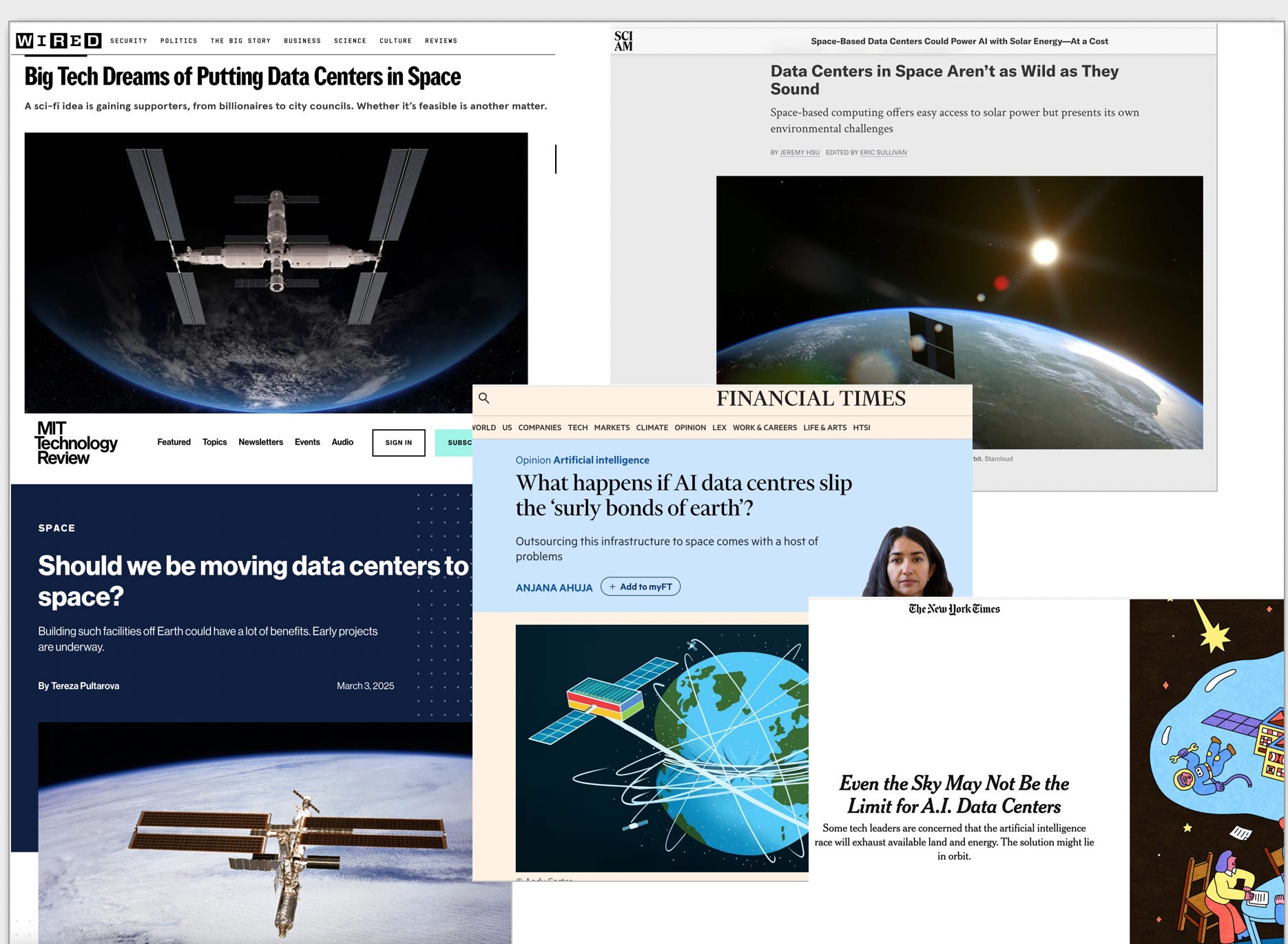
And before you know it, it’s everywhere; Wired, the Scientific American, MIT Review, even the New York times last week (do keep up NYT) and soon it really starts to look like a serious proposition.
It is not – which is very obvious after a few minutes looking at it.
Here’s a summary:
2025 was a record year for putting stuff in space; we (well, Elon Musk, actually) put 2,600 tons in orbit.
The biggest thing we’ve ever put into orbit is the International Space Station at 420 tons. 118 tons of that is a power and cooling system, which provides on average 150kw of power.
This is because if you heat or power something in space, there’s only one way to keep it cool: massive radiators. They work in exactly the same way as the radiators in your living room, but in reverse; they go on the outside. And they need to be really big; there is no way around this.

So, to power a 1 gigawatt data centre in space with similar technology, we’d need 666,000 tons of solar panels and cooling radiators.
For some context, the world’s largest aircraft carrier weighs 100,000 tons. Incl. 75 aircraft.
So then: 6+ aircraft carriers going up to space in rockets. And 450 aircraft.

Then there’s the carbon emissions. If we used Starship, SpaceX’s latest and biggest rocket, we’d emit about 337 million tons of carbon to get all that into space.
About the UK’s entire carbon emissions for 1 year.
But emitting gasses and soot particles high up in the stratosphere has a much bigger impact on global warming.
That’s for 1 Gigawatt; which is a truly massive data centre. But tech companies are planning 50GW of new data centres in the US by 2030.
Then there are other space issues, like...you know, radiation destroying pretty much everything, server maintenance, massive structures crashing into each other, vast solar arrays blocking our sunlight, space junk etc etc.
But they’re just technical matters. No doubt AI can sort those out soon.
So there are a few problems with the basic idea here.
Did tech CEOs somehow miss all this?
And this is just when the hard planetary limits of building gargantuan AI data centres on earth are becoming all too clear.
In the US, data centres are bringing energy grids to breaking point, they are massively aggravating water stress; over 200 local groups are resisting data centres near them. Politicians on the left and even the populist right are calling for a moratorium.
So you can see why Silicon Valley might want us to believe they can tap into unlimited clean energy in space.
All these earthly problems are just a temporary glitch, before all their data centres are pinged into orbit.
They may well truly believe planetary limits simply don’t apply to them. And in a sense they don’t, as they know it’s the rest of us who will pick up the bill.
Meanwhile, they carry on building regardless.
There are some additional aspects of our 1GW spacebound data centre that we might also consider.
Firstly we only considered the weight of the heat and cooling required.
The data centre itself would weight quite a bit too. The latest AI server rack is the Nvidia NVL72s– each one has 36 GB300 GPU chips – and they weigh1.64 tons. For a 1GW data centre we’d need 6666 of those, so that’s another 10,600 tons. And 1GW also needs about 30,000 tonnes of copper cabling.
Now of course the design of these things would change in space – but we have no idea if the hardware with the same functions could be produced with less weight. Maybe, but we have no idea – it cold easily be more.
And of course then there’s the structure to house them – its hard to imagine what that would require – but it would have to be significant.
One is cost – currently the cheapest cargo into orbit, is with SpaceX’s Falcon Heavy – at around $1,500 kg – or $1.5 million per ton. So for our 1GW data centre we’re up to around $1 trillion. Of course you’d hope for steep discount with all that ferrying up and down – but considering a 1GW on earth is around $35bn, it would need to be quite a steep discount.
One other aspect is the solar panels – actually, the ISS has panels for 300kw of power, but as it has only 150kw of cooling capacity, it can’t use its full power for very long, otherwise it’ll turn into a slow cooker for its residents.
That said, for our 1GW data centre we’ll need about 8 square km of solar panels, which would be an enormous structure visible from earth, and nearly three times the size of Central Park in New York.
You may well be thinking that with sufficient attention and resources we’ll be able to innovate far more viable solutions, and with components a fraction of the size.
There could be some progress, but it is likely to be incremental. Here we are talking about basic energy characteristics of physical objects. These can improve over time – but not fast.
Take solar panels – which are a key part of this. In 2000 the top solar panels achieved about 20 per cent efficiency. In 2025 the top solar panels can reach ...24 per cent efficiency; a 20 per cent increase in 25 years. That’s quite good progress, actually. But Moore’s law this is not.
So we’re not going to see dramatic changes in a relevant timescale.
So the closer you look, the clearer it is that these plans are more about Silicon Valley’s adolescent fascination with space, which by now has been exhaustively – and exhaustingly – documented, than it is with rational analysis.
And of course this doesn’t stop with data centres.
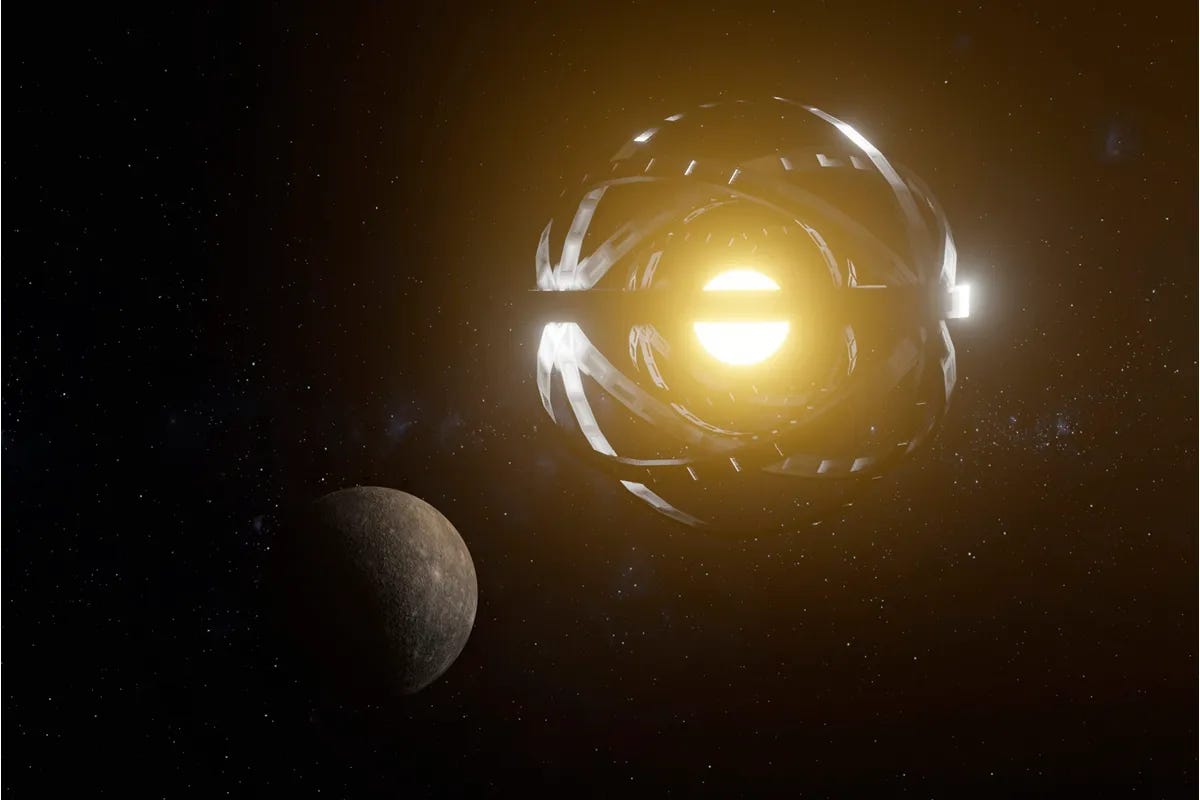
Sam Altman loves to discuss Dyson spheres – that is vast solar arrays that completely surround a Sun – possible ours, or possibly another, a few light years away. Why ever not?
Jeff Bezos is very keen on the idea of mining in space:
“The reason we’ve got to go to space, in my view, is to save the Earth; A very fundamental long-range problem is that we will run out of energy on Earth.
“This is just arithmetic. It will happen.”
And of course there’s Elon Musk’s lifelong ambition to colonise Mars.
So compared to these plans, putting data centres in space is really quite modest proposal.
It is notable here that all these tech CEOs are fully aware of the planetary systems collapse that awaits us on our current trajectory.
And it’s important to note that all of them feel by far the most prudent thing to do about the escalating energy crisis (that they are accelerating) is to..... wrap solar panels around a sun.
These are definitely not the kind of people you need around in a climate crisis.
Thanks for reading this far -
Hopefully I’ll have a few more articles coming out in the next few weeks - hopefully more reflective - on why we’re probably not reaching AGI anytime soon; and why the people telling us we’ll never work again are working 100 hour weeks?
I’ll also be looking at AI and inreality.
As well as tools to disconnect and to reconnect … back to reality.
do leave a comment - i love to hear your thoughts.,
Some more details on the sources
The numbers i used here are quite straightforward – the basic details of the International Space Station can be found here:
On rockets –there is some basic information on SpaceX Starship on Wikipedia : https://en.wikipedia.org/wiki/SpaceX_Starship
Its projected payload is around 150 tonnes – far bigger than any previous rocket.
https://www.space.com/spacex-starship-rocket-launches-environmental-impact
76,000 tonnes CO2 for 150 tons of data centre – so that means for 666,000 tons we’ll need 4666 launches.
That comes to 355 million tonnes of carbon.
And it should be noted we really don’t know the full impact of carbon and soot particle emissions at very high altitudes – we don’t even know the impact with aviation. But that is often factored in at twice the normal impact – for space flights its likely to be worse.
If all your reasons weren't enough, chips degrade from radiation. Explained here by an engineer who has designed systems for satellites:
https://taranis.ie/datacenters-in-space-are-a-terrible-horrible-no-good-idea/